Research Article | | Peer-Reviewed

Research on Automatic Testing Methods for IPU Power Supplies

Received: 13 November 2025     Accepted: 18 December 2025     Published: 27 December 2025
Views:       Downloads:
Abstract

As the core power supply unit of the railway communication signal system, the operational stability and performance reliability of the IPU power supply are directly related to railway transportation safety. The railway signal field has extremely stringent requirements for high reliability, high stability, and adaptability to extreme operating conditions of power supply equipment. Addressing the technical bottlenecks of traditional IPU power supply testing, such as complex environmental setup, high manual intervention, time-consuming non-coplanar interface docking (5-8 minutes for single device preparation), incomplete test coverage (lack of voltage/load boundary scenario testing), and poor result consistency, this paper proposes a fully automated testing method for IPU power supplies tailored to railway signal scenarios. This method innovatively adopts a technical architecture of "moving spring probe docking + programmable excitation + multi-dimensional monitoring". Relying on the automatic alignment and elastic fitting characteristics of customized moving spring probes, combined with the bidirectional fixing mechanism of electric cylinders, it achieves high-speed and precise docking of multiple interfaces. Through programmable power supply/load generation of rated and boundary voltage and multi-load combination excitation, coupled with a 16-bit high-precision ADC acquisition circuit, a data acquisition system is constructed. Integrating image recognition technology based on HSV color threshold segmentation, it completes visual monitoring of lamp position status and screen parameters, and integrates a "recognition-recording-retry-alarm" fault adaptive processing mechanism to enhance the stability of the testing process. Experimental verification results show that the testing time for a single IPU power supply is reduced from 15 minutes to 4 minutes, a 60% reduction compared to traditional methods. The fault recognition accuracy rate is over 98%, supporting parallel testing of 10 devices, with a batch testing efficiency increase of 73.3%. It comprehensively covers key performance indicator testing scenarios. This solution effectively eliminates manual operation errors, improves the standardization and traceability of the testing process, and provides efficient and reliable technical support for the quality control of IPU power supply mass production, meeting the stringent application requirements of railway signal equipment.

Published in Journal of Electrical and Electronic Engineering (Volume 13, Issue 6)
DOI 10.11648/j.jeee.20251306.14
Page(s) 278-285
Creative Commons

This is an Open Access article, distributed under the terms of the Creative Commons Attribution 4.0 International License (http://creativecommons.org/licenses/by/4.0/), which permits unrestricted use, distribution and reproduction in any medium or format, provided the original work is properly cited.

Copyright

Copyright © The Author(s), 2025. Published by Science Publishing Group

Keywords

IPU Power Supply, Automatic Testing Method, Mobile Spring Probe Docking

1. Introduction
As the core power supply equipment of the railway communication signaling system, the operational stability of the IPU power supply directly determines railway transportation safety. Traditional IPU power supply testing relies on manually plugging and unplugging interfaces to set up the environment , requiring repeated adjustments of non-coplanar interfaces (such as two Ethernet ports and four IO ports), with preparation time for a single device reaching 5-8 minutes . At the same time, voltage and current data need to be manually recorded, and the LED status needs to be manually judged , leading to issues such as missed data recording and delayed fault identification.
More critically, traditional testing methods focus on basic functionality verification and lack performance testing for voltage boundaries (176V, 264V) and load boundaries, making it difficult to expose potential risks under extreme conditions . The output stability of the IPU power supply under extreme voltage can be quantitatively evaluated using the voltage regulation rate formula:
Su=Uno_load-Ufull_loadUrated×100(%)(1)
Among them, Uno_loadis the no-load output voltage, Ufull_load is the full-load output voltage, and Urated is the rated output voltage. Due to the limitations of manual operation, traditional methods cannot accurately obtain Su values across different voltage ranges, leading to incomplete performance evaluation; moreover, they cannot achieve parallel testing of multiple devices, making batch testing inefficient and unable to meet the demands of large-scale production of railway equipment . Therefore, studying an automated, high-precision, and comprehensive IPU power supply testing method is of significant practical importance.
Address the pain points of traditional IPU power testing by researching and proposing an automated testing method that integrates 'automatic interface docking, intelligent stimulus generation, real-time status monitoring, automatic data analysis, and adaptive fault handling.' It must meet three requirements: first, shorten the time for environment setup and achieve precise one-time docking of multiple interfaces; second, improve test comprehensiveness to cover all functional and performance scenarios; third, enhance batch testing efficiency and support parallel testing of multiple devices.
2. Overall Design of Automated Testing Method
2.1. Principles of Method Design
The automatic testing method for IPU power supplies follows the three main principles of 'efficiency, accuracy, and compatibility:
1). Efficiency: By using automated integration and parallel testing, reduce manual intervention time and improve the testing efficiency of both single units and batches ;
2). Accuracy: Employ high-precision data acquisition and intelligent recognition technologies to ensure controllable test data errors and accurate fault determination ;
3). Compatibility: Adapt to the interface specifications and testing requirements of different IPU power supply models, supporting flexible configuration of test parameters .
2.2. Core Framework of the Method
This method centers on 'test process automation' and establishes a closed-loop testing system of 'connection - stimulus - monitoring - analysis - handling,' with the specific framework as follows:
1). Interface Automatic Connection Layer: Uses mobile spring connection technology to achieve precise one-time connections for all IPU interfaces, replacing manual plugging and unplugging;
2). Test Stimulus Generation Layer: Generates combined test conditions of voltage and load through programmable power and load, covering rated, boundary, and overload scenarios ;
3). Multi-Dimensional Monitoring Layer: Integrates ADC data acquisition and image recognition to simultaneously obtain electrical parameters (voltage, current) and physical states (lamp positions, screens);
4). Automated Data Analysis Layer: Performs real-time analysis and result determination of test data based on preset standard values and algorithmic models;
5). Fault Adaptive Handling Layer: Integrates fault recording, device restart, and retry mechanisms to ensure the continuity of the testing process.
3. Design of Key Methods for Automated Testing
3.1. Interface Automatic Integration Method
3.1.1. Device Bidirectional Locking Mechanism
To ensure docking accuracy, a bidirectional fixing method of 'one side fixed, the other side clamped by an electric cylinder' is used: the side of the IPU power supply to be tested is fixed with a mechanical positioning block, while the other side is clamped by an electric cylinder. The clamping force is controlled in a closed loop through a pressure sensor, satisfying the formula:
Fclamp=k×m×g(2)
Here, k is the safety factor (3.6-4.5), m is the maximum weight of the IPU (5kg), g is the acceleration due to gravity (9.8 m/s2), resulting in a clamping force range of 176.4-220.5N, with a fixing precision of ±0.1mm to prevent equipment displacement during docking.
3.1.2. Multi-interface Synchronous Integration Technology
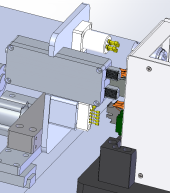
Figure 1. Multi-Interface Integration Technology Diagram.
For the multi-non-coplanar interface characteristics of the IPU, multiple sets of movable spring pins of different sizes (diameter 0.3-0.8mm, stroke 1-3mm) were customized. By synchronously controlling the probe positions with a motor, interfaces such as Ethernet, IO, and power can be connected at once. A schematic diagram of the multi-interface connection technology is shown in Figure 1.
The docking error is controlled through the following model:
x=xmotor+xspring+xinstall(3)
Among them, xmotor is the motor positioning error (±0.02mm), xspring is the elastic deformation error of the spring pin (±0.03mm), and xinstall is the installation error (±0.05mm). The total error is ≤ ±0.1mm, and the docking time is reduced to within 10 seconds (compared to 5-8 minutes with traditional methods).
3.2. Testing Incentive Generation Methods
3.2.1. Voltage Excitation Generation
Using a programmable 220V AC power supply to generate excitation at different voltage levels, including rated voltage (220V), boundary voltages (176V, 264V), and fluctuating voltages (±20% of the rated value), to verify the stability of the IPU under voltage fluctuations. The voltage output accuracy meets:
U=|Uset-Uactual|0.1(V)(4)
At the same time, the 220V to 24V DC module provides basic power supply for the test system (industrial computer, camera), with a ripple factor ≤1% to ensure a stable testing environment. The ripple voltage test data are shown in the Table 1.
Table 1. Ripple Voltage Test Data.

Input Voltage (V)

Output Voltage (V)

Ripple Voltage (mV)

Ripple Factor (%)

176(-20%)

23.8

182

0.76

220 (rated)

24.0

169

0.70

264(+20%)

24.1

191

0.79

3.2.2. Load Excitation Generation
A multi-channel programmable electronic load is used to generate different load scenario stimuli, including rated load, light load, and overload, to verify the IPU's load capacity and dynamic response. The load step response time meets:
tr10ns(5)
Here,tr refers to the rise time from 10% load to 90% load, ensuring the capture of the IPU's dynamic output characteristics.
3.3. Multi-dimensional Monitoring Method
3.3.1. Electrical Parameter Collection
A 16-bit high-precision ADC acquisition circuit is used to collect the IPU output voltage and current in real time, with a sampling frequency of 1 kHz. The data is processed through an RC low-pass filter before being uploaded for analysis. The filter transfer function is :
H(s)=11+RC·s(6)
Among them, R = 1 kΩ, C = 0.1 μF, cutoff frequency fc1592Hz, effectively filtering high-frequency noise, voltage measurement accuracy ±0.01 V, current measurement accuracy ±0.01 A.
3.3.2. Physical State Recognition
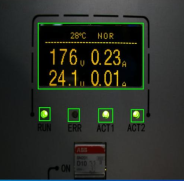
Using a 2-megapixel industrial camera, IPU light positions and screen images are captured every 0.5 seconds, and status monitoring is achieved through 'color threshold segmentation and OCR recognition' The recognition images of IPU light positions and screens are shown in Figure 2.
Figure 2. IPU Lamp Position and Screen Image Recognition.
1. Light Position Recognition: A color threshold segmentation algorithm is used, with HSV color space threshold ranges shown in Table 2, to identify the LED light position color (red/green/yellow) and status (on/off/blinking). If situations such as "should be on but not" or "abnormal blinking" occur, it is determined to be a fault.
Table 2. HSV color space threshold range.

Light Color

H Range

S Range

V Range

Recognition Accuracy (%)

Red

0-10

120-255

100-255

99.2

Green

35-77

120-255

100-255

99.5

Yellow

20-30

120-255

100-255

98.8

2. Screen recognition: Extract screen voltage and current readings via OCR and compare them with ADC collected data (error threshold ±0.5%); use the Sobel operator for edge detection to determine if the screen is displaying garbled visuals . The edge detection formula is:
Gx=-101-202-101×I (7)
Gy=-1-2-1000121×I (8)
G=Gx2+Gy2 (9)
When the mean value of G is less than 20, it is determined to be a screen distortion fault . The total delay of image acquisition and recognition is less than 200 ms to ensure real-time status monitoring.
3.4. Fault Adaptive Handling Method
To address unexpected failures during the testing process, an adaptive handling process of 'Detect - Record - Retry - Alert' is designed:
1. Fault Detection: Determine the type of fault based on electrical parameter deviations (e.g., voltage exceeding rated value ±5%) or abnormal physical conditions (e.g., a lamp that should be on is not illuminated);
2. Fault Recording: Automatically record the time of occurrence, fault type, and test parameters at the time, forming a fault log ;
3. Automatic Retry: Restart the device and re-execute the current test step (up to 2 retries) to eliminate intermittent faults;
4. Alert Notification: If the fault persists after retries, stop testing on the device and trigger audible and visual alarms to prompt manual intervention.
4. Automated Test Process Design
Based on the above key methods, design an automatic testing process for IPU power supplies, divided into 'single device testing process' and 'batch testing process'.
4.1. Single Device Testing Process
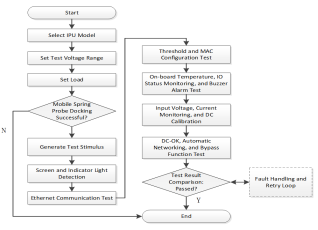
Figure 3. IPU Power Supply Single Device Automatic Test Flowchart.
Using a six-step process of 'parameter configuration→docking and clamping→stimulus generation→ multi-dimensional monitoring→result determination→fault handling,' the automatic testing flowchart for a single IPU power supply device is shown in Figure 3.
1. Parameter Configuration: Select the IPU model, set the test voltage range (176-264V), and define the load scenario (rated or overload);
2. Coupling and Clamping: The motor drive moves the spring to align with the IPU interface, and the electric cylinder applies the clamping force;
3. Excitation Generation: The programmable power supply and load output are configured with voltage and load parameters to generate the test excitation ;
4. Multi-dimensional Monitoring: ADC collects electrical parameters, cameras capture the physical state, and data is uploaded in real time; Result Evaluation: Compare the collected data with standard values (e.g., voltage adjustment rate Su ≤ 2%) and, in conjunction with state recognition results, determine whether the test passes ;
5. Fault Handling: If a fault is detected, execute the fault-adaptive handling procedure (record – retry – alert).
4.2. Batch Testing Process
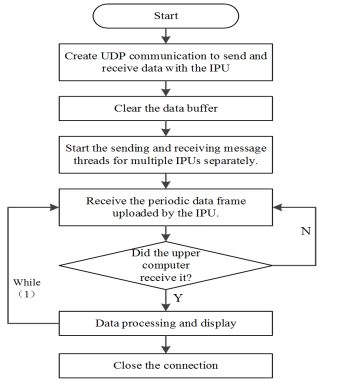
Figure 4. Batch Testing Process.
To meet the requirements of multi-device parallel testing, a batch process of 'Networking - Configuration - Synchronization - Summary' is designed. The batch testing flowchart is shown in Figure 4.
1. Device Networking: 10 IPU power units are connected to the industrial computer through a switch, with each assigned an individual IP address (192.168.1.101-192.168.1.110);
2. Batch Configuration: The host computer sends test parameters to all devices in batch;
3. Synchronized Testing: Start testing the 10 devices sequentially, displaying each device's progress in real time (e.g., '20%', 'Completed') and status (Normal / Fault);
4. Data Summary: After testing, the results of the 10 devices are automatically aggregated, generating a batch report with the pass/fail status of each device along with the cause of any faults.
The efficiency improvement model for batch testing is:
η=Tmanual×N-TautoTmanual×N×100(%)(10)
Here, Tmanual is the traditional single-device test time (15 minutes), Tauto is the batch test time (40 minutes), and N is the number of testing devices (10 units), resulting in an efficiency of η= 73.3%.
5. Validation Scheme Design and Result Analysis
5.1. Validation Plan Design
To verify the effectiveness of the method, 100 IPU-II power supplies were selected to compare key indicators between traditional manual testing and this method. The test environment parameters were: temperature 25±2℃, humidity 45-65% RH, vibration ≤0.1g . The test indicators included single-unit test time, fault detection accuracy, batch test quantity, data storage integrity, interface connection success rate, data acquisition accuracy, and continuous operation stability.
5.2. Test Results Statistics
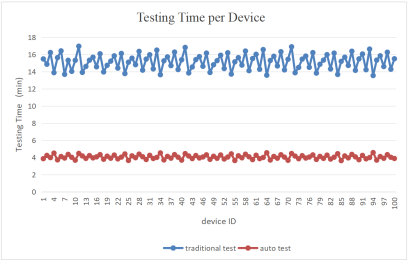
The statistical results of the experimental data are shown in Table 3. The system automatic testing method proposed in this paper can significantly improve testing efficiency and reliability. A line chart comparing the testing time of a single device between traditional manual testing and the automatic testing of this system is shown in Figure 5.
Table 3. Experimental Data Statistics Table.

Test Indicators

Traditional Manual Testing

Auto Testing of This System

Improvement Effect

Testing Time per Device

15 minutes

4 minutes

Reduced by 60%

Test Accuracy (Fault Detection)

85%

98%

Increased by 13 percentage points

Number of Devices Tested per Batch

1 device

10 devices

Increased by 9 times

Integrity of Test Data Storage

60%

100%

Increased by 40 percentage points

Interface Docking Success Rate

92%

99.8%

Increased by 7.8 percentage points

Data Acquisition Accuracy (Voltage)

±0.1V

±0.01V

Improved by 10 times

Continuous Operation Stability

90%

99.9%

Increased by 9.9 percentage points

Figure 5. Comparison Chart of Single Device Testing Time.
5.3. Result Analysis
1. Efficiency Improvement: Through the mobile spring docking technology, interface connection time is reduced from 5-8 minutes to under 10 seconds; batch testing supports 10 units in parallel, significantly lowering labor and time costs.
2. Accuracy Improvement: By combining 16-bit ADC acquisition with image recognition technology, voltage acquisition accuracy reaches ±0.01V, with a fault recognition accuracy of 98%, avoiding manual reading errors and judgment deviations; the voltage adjustment measurement error is ≤0.2%, far better than the 5% error of traditional methods, allowing for more precise performance evaluation.
3. Stability Improvement: Fault-adaptive handling and continuous 72-hour stability tests show that the method's operating failure rate is ≤0.1%, meeting the long-term testing requirements for large-scale production; data storage integrity is 100%, solving the problem of missing manual records and providing complete data support for quality traceability.
6. Conclusions
The IPU power supply automatic testing method studied in this paper realizes full-process automation of IPU power supply testing through the technical combination of 'mobile spring docking, program-controlled excitation, multidimensional monitoring, and fault-adaptive handling,' effectively addressing the issues of low efficiency, poor accuracy, and incomplete coverage in traditional testing. The core innovations of this method are: first, proposing a multi-interface synchronous docking mechanism to shorten environment setup time; second, constructing a 'electrical and physical' multidimensional monitoring model to enhance test completeness; and third, designing a batch parallel testing process to accommodate large-scale production requirements.
Abbreviations

IPU

Industrial Power Unit

IO

Input/Output

LED

Light-emitting Diode

ADC

Analog-to-digital Converter

OCR

Optical Character Recognition

HSV

Hue, Saturation, Value

IP

Internet Protocol

Author Contributions
Caiqi Li is the sole author. The author read and approved the final manuscript.
Data Availability Statement
The data supporting the outcome of this research work has been reported in this manuscript.
Conflicts of Interest
The author declares no conflicts of interest.
References
[1] Li Xiaopeng, Wang Yu, Xue Chao, et al. Research on Measurement Method of Odometer [J]. Railway signalling & communication engineering, 2024, 21(3): 77-82.
[2] Jiang Yunwei, Ai Qiangwa, Wu Peidong. Research and Implementation of a General Automatic Testing Platform for Vehicle ATP [J]. Railway signalling & communication engineering, 2024, 21(11): 9-16.
[3] Huang Fei. Research and Implementation of General Automatic Test Platform for Onboard ATP [J]. Modern Information Technology, 2025, 9(6): 67-70.
[4] Huang Hu, Hu Weiwei, Zhou Yifeng, et al. A multifunctional automated power supply test bench [J]. Electric Welding Machine, 2017, 47(12): 47-50.
[5] Yang Peigang, Cao Xiaoyu, Liang Chunyan. Research and Application of Automatic Testing Tool for Data Control Center Equipment in Heavy-Haul Railways [J]. Railway signalling & communication engineering, 2025, 22(3): 46-52, 130.
[6] Peng Dong, Cui Yan, Cao Yaxin. Design and Implementation of an All-Electronic Interlocking Automatic Testing Platform [J]. Railway Communication and Signal Engineering Technology, 2024, 21(5): 32-37,61.
[7] Chen Bidong. Research on Image Recognition Technology in Intelligent Inspection Systems for Signal Equipment Rooms [J]. Railway Signalling & Communication Engineering, 2025, 22(9): 115-121.
[8] Wang Rui. The Application of Virtual Instrument Technology in the Testing and Measurement of Railway Equipment [J]. China Railway, 2024(6): 153-158.
[9] Chen Yuanliang, Ma Fuchen, Zhou Yuanhang, et al. A Review of Dynamic Testing Techniques for Distributed Systems [J]. Journal of Software, 2025, 36(7): 2964-3002.
[10] Huang Hao, Wang Faxiang. Design of a Digital Decimation Filter for Sigma Delta ADC [J]. Electronics Production, 2024, 32(3): 18-22.
[11] Sun Zhike. Research on Development of Interlocking Automatic Test Tool Using Image Recognition Technology [J]. Railway signalling & communication engineering, 2023, (2): 11-16.
[12] Wen Yan, Guo Xiaoqian, Tang Youzhi, et al. Crack Identification Technology Based on Sobel Matching Filter Joint Algorithm [J]. China and Foreign Highways, 2025, 45(4): 33-41.
[13] Song Qiannán, Liu Guangzhu, Wu Lelin, et al. Design of an FPGA Image Edge Detection System Based on Sobel [J]. Electronic Measurement Technology, 2024, 47(13): 68-73.
[14] Gao Yang, Lü Mo, Cui Guangwu. Handling of Train Communication Network Failures and Failure Mode Analysis [J]. Urban Rail Transit Research, 2023, 26(4): 140-144.
[15] Yan Zhanxia. Research on the Simulation of Signal Equipment Operation and Automatic Generation of Test Cases for Railway Section Automatic Block Systems Testing and Evaluation Platform [D]. Shanghai: Tongji University, 2005.
[16] Yang Peigang, Cao Xiaoyu, Liang Chunyan. Research and Application of Automatic Testing Tool for Data Control Center Equipment in Heavy-Haul Railways [J]. Railway Signalling & Communication Engineering, 2025, 22(3): 46-52, 130.
[17] Yu Wenbin, Qiu Zhaoyang. Research on the Testing and Verification Method of Railway Signal Equipment Based on Extended Finite State Machines [J]. Journal of the Railway, 2025, 47(2): 3-91.
Cite This Article
  • APA Style

    Li, C. (2025). Research on Automatic Testing Methods for IPU Power Supplies. Journal of Electrical and Electronic Engineering, 13(6), 278-285. https://doi.org/10.11648/j.jeee.20251306.14

    Copy | Download

    ACS Style

    Li, C. Research on Automatic Testing Methods for IPU Power Supplies. J. Electr. Electron. Eng. 2025, 13(6), 278-285. doi: 10.11648/j.jeee.20251306.14

    Copy | Download

    AMA Style

    Li C. Research on Automatic Testing Methods for IPU Power Supplies. J Electr Electron Eng. 2025;13(6):278-285. doi: 10.11648/j.jeee.20251306.14

    Copy | Download

  • @article{10.11648/j.jeee.20251306.14,
      author = {Caiqi Li},
      title = {Research on Automatic Testing Methods for IPU Power Supplies},
      journal = {Journal of Electrical and Electronic Engineering},
      volume = {13},
      number = {6},
      pages = {278-285},
      doi = {10.11648/j.jeee.20251306.14},
      url = {https://doi.org/10.11648/j.jeee.20251306.14},
      eprint = {https://article.sciencepublishinggroup.com/pdf/10.11648.j.jeee.20251306.14},
      abstract = {As the core power supply unit of the railway communication signal system, the operational stability and performance reliability of the IPU power supply are directly related to railway transportation safety. The railway signal field has extremely stringent requirements for high reliability, high stability, and adaptability to extreme operating conditions of power supply equipment. Addressing the technical bottlenecks of traditional IPU power supply testing, such as complex environmental setup, high manual intervention, time-consuming non-coplanar interface docking (5-8 minutes for single device preparation), incomplete test coverage (lack of voltage/load boundary scenario testing), and poor result consistency, this paper proposes a fully automated testing method for IPU power supplies tailored to railway signal scenarios. This method innovatively adopts a technical architecture of "moving spring probe docking + programmable excitation + multi-dimensional monitoring". Relying on the automatic alignment and elastic fitting characteristics of customized moving spring probes, combined with the bidirectional fixing mechanism of electric cylinders, it achieves high-speed and precise docking of multiple interfaces. Through programmable power supply/load generation of rated and boundary voltage and multi-load combination excitation, coupled with a 16-bit high-precision ADC acquisition circuit, a data acquisition system is constructed. Integrating image recognition technology based on HSV color threshold segmentation, it completes visual monitoring of lamp position status and screen parameters, and integrates a "recognition-recording-retry-alarm" fault adaptive processing mechanism to enhance the stability of the testing process. Experimental verification results show that the testing time for a single IPU power supply is reduced from 15 minutes to 4 minutes, a 60% reduction compared to traditional methods. The fault recognition accuracy rate is over 98%, supporting parallel testing of 10 devices, with a batch testing efficiency increase of 73.3%. It comprehensively covers key performance indicator testing scenarios. This solution effectively eliminates manual operation errors, improves the standardization and traceability of the testing process, and provides efficient and reliable technical support for the quality control of IPU power supply mass production, meeting the stringent application requirements of railway signal equipment.},
     year = {2025}
    }
    

    Copy | Download

  • TY  - JOUR
    T1  - Research on Automatic Testing Methods for IPU Power Supplies
    AU  - Caiqi Li
    Y1  - 2025/12/27
    PY  - 2025
    N1  - https://doi.org/10.11648/j.jeee.20251306.14
    DO  - 10.11648/j.jeee.20251306.14
    T2  - Journal of Electrical and Electronic Engineering
    JF  - Journal of Electrical and Electronic Engineering
    JO  - Journal of Electrical and Electronic Engineering
    SP  - 278
    EP  - 285
    PB  - Science Publishing Group
    SN  - 2329-1605
    UR  - https://doi.org/10.11648/j.jeee.20251306.14
    AB  - As the core power supply unit of the railway communication signal system, the operational stability and performance reliability of the IPU power supply are directly related to railway transportation safety. The railway signal field has extremely stringent requirements for high reliability, high stability, and adaptability to extreme operating conditions of power supply equipment. Addressing the technical bottlenecks of traditional IPU power supply testing, such as complex environmental setup, high manual intervention, time-consuming non-coplanar interface docking (5-8 minutes for single device preparation), incomplete test coverage (lack of voltage/load boundary scenario testing), and poor result consistency, this paper proposes a fully automated testing method for IPU power supplies tailored to railway signal scenarios. This method innovatively adopts a technical architecture of "moving spring probe docking + programmable excitation + multi-dimensional monitoring". Relying on the automatic alignment and elastic fitting characteristics of customized moving spring probes, combined with the bidirectional fixing mechanism of electric cylinders, it achieves high-speed and precise docking of multiple interfaces. Through programmable power supply/load generation of rated and boundary voltage and multi-load combination excitation, coupled with a 16-bit high-precision ADC acquisition circuit, a data acquisition system is constructed. Integrating image recognition technology based on HSV color threshold segmentation, it completes visual monitoring of lamp position status and screen parameters, and integrates a "recognition-recording-retry-alarm" fault adaptive processing mechanism to enhance the stability of the testing process. Experimental verification results show that the testing time for a single IPU power supply is reduced from 15 minutes to 4 minutes, a 60% reduction compared to traditional methods. The fault recognition accuracy rate is over 98%, supporting parallel testing of 10 devices, with a batch testing efficiency increase of 73.3%. It comprehensively covers key performance indicator testing scenarios. This solution effectively eliminates manual operation errors, improves the standardization and traceability of the testing process, and provides efficient and reliable technical support for the quality control of IPU power supply mass production, meeting the stringent application requirements of railway signal equipment.
    VL  - 13
    IS  - 6
    ER  - 

    Copy | Download

Author Information