
As a critical component of railway systems, existing trackside equipment relies on centralized indoor power supply screens for power. However, this configuration suffers from inherent drawbacks such as excessive cable lengths, high deployment costs, and significant voltage fluctuations. To address these issues and adapt to the distributed control scenarios of urban rail transit, this paper proposes a safety-oriented, digitally controllable AC/DC conversion circuit design tailored for trackside installation and miniaturization. Adhering to the "fault-safety" principle and "two-out-of-two" redundancy architecture, the circuit converts mains AC220V to adjustable DC output ranging from 24V to 200V. The module integrates a dual-processor control unit, power conversion circuit, voltage/current acquisition circuit, and weak current voltage conversion circuit. Key design features include electrical isolation via a high-frequency transformer, enhanced power conversion efficiency through phase-shifted full-bridge control, real-time monitoring of input/output voltage, output current, and board temperature, and bidirectional real-time communication with external devices. Notably, the circuit is designed to fail safely: in the event of abnormal acquisition signals or hardware malfunctions, the system automatically switches to a safe state with no power conversion output. To validate the design feasibility, a 1kW experimental prototype was fabricated and tested, with results confirming the effectiveness of the proposed solution.
| Published in | Journal of Electrical and Electronic Engineering (Volume 14, Issue 1) |
| DOI | 10.11648/j.jeee.20261401.11 |
| Page(s) | 1-8 |
| Creative Commons |
This is an Open Access article, distributed under the terms of the Creative Commons Attribution 4.0 International License (http://creativecommons.org/licenses/by/4.0/), which permits unrestricted use, distribution and reproduction in any medium or format, provided the original work is properly cited. |
| Copyright |
Copyright © The Author(s), 2026. Published by Science Publishing Group |
Trackside Equipment, AC/DC Conversion, Digital Controllability, Fault-safety, Distributed Power Supply
Parameter | Specification |
|---|---|
Input voltage | AC220V ±10% (50Hz) |
Output voltage range | DC24V~DC200V (continuously adjustable) |
Rated power | 1kW |
Conversion efficiency | ≥92% (full load) |
Output voltage deviation | ≤±5% |
Fault response time | ≤10ms |
Working temperature | -40°C~+70°C |
Communication interface | Ethernet (100Mbps) |
Safety standard | EN 50159, GB/T 28029 |
Hannel | Frequency (kHz) | Duty Cycle Range | Signal Integrity |
|---|---|---|---|
1 | 100.2 | 0.1~0.9 | Good |
2 | 99.8 | 0.1~0.9 | Good |
3 | 100.1 | 0.1~0.9 | Good |
4 | 99.9 | 0.1~0.9 | Good |
Target Voltage (V) | Measured Voltage (V) | Deviation (%) | Compliance |
|---|---|---|---|
24 | 25.1 | +4.58 | Qualified |
200 | 201.2 | +0.60 | Qualified |
Fault Type | Test Condition | Response Time (ms) | Result |
|---|---|---|---|
Single CPU failure | Disable CPU1/CPU2 | <1 | Immediate DC output termination |
Abnormal acquisition data | Inject invalid voltage/current signals | 8.2 | Fail-safe shutdown |
Input overvoltage | Vin = 264V (120% rated) | 3.5 | Automatic output cutoff |
Output overcurrent | Iout = 5A (125% rated at 200V output) | 2.8 | Automatic output cutoff |
PWM | Pulse Width Modulation |
CPU | Central Processing Unit |
FPGA | Field Programmable Gate Array |
DC | Direct Current |
AC | Alternating Current |
MOSFET | Metal-Oxide-Semiconductor Field-Effect Transistor |
| [1] | Shi W S, Huang Z I, Shang H. Intelligent Operation and Maintenance System for Urban Rail Transit Switch Machines. Urban rapid transit, 2024, 37(3): 69-74. |
| [2] | Huang Z I, Shi W S. Diagnosis and Analysis Method for Common Faults in Control Circuit of AC Switch Machine. Railway Signalling & Communication Engineering, 2025, 22(2): 116-122. |
| [3] | Liu J L. Research on Signal Power Supply System for Hungary-Serbia Railway. Railway Signalling & Communication Engineering. 2023 20(4): 101-104. |
| [4] | Zhang J. Research on Key Technologies for the Renovation of DC Power Supply Devices on Subway Tracksides. Digital users. 2025(28): 70-72. |
| [5] | Xue Z H. Application of Intelligent Analysis System for Indoor and Outdoor Operation Status of Railway Signal Machine. Transportation World. 2025(9): 18-20. |
| [6] | Qin F Z. Improvement of Intelligent Power Supply Screen Circuit. Management and Technology of Small and Medium sized Enterprises. 2015, 10, pp. 207-208. |
| [7] | Bao J Y. Analysis and countermeasures of timing problems of intelligent power` panel module. Railway Signalling & Communication Engineering. 2022, 19(3), pp. 95-99. |
| [8] | Tang S B. Design of Integrated Circuit for Efficient Single-Chip AD/DC Power Management. Telecom Power Technology. 2022 39(12): 82-85. |
| [9] | LIU L, YANG Z M, HUANG Q. Key method of digitization of power distribution panel with artificial intelligence identification for power communication network. Telecommunication Science. 2025 41(4): 176-190. |
| [10] | Cheng R, Ren X G, Xing M L and Liu H Y. Design of Distributed Switch Controller. System Railway Signalling & Communication Engineering. 2024, 21(8), pp. 86-91. |
| [11] | Yin B, Li L Z. Application Analysis of Lithium Iron Phosphate Batteries in 48 V Railway Communication Power Supply. Railway Signalling & Communication Engineering. 2025, 22(4), pp. 64-70. |
| [12] | Li C J and Ren X G. Design of Drive Module of Nodeless DC Switch Machine. Railway Signalling & Communication Engineering. 2022, 19(10), pp. 19-23. |
| [13] | Xing M L, Ding H, Ren X G, Huang B B, Ao Q and Xiao Y P. Design of the Safe Driving and Acquisition Module for Nodeless Three-phase AC Switch Machines. 2021, 5th International Conference on Computer Science and Application Engineering. |
| [14] | Zhang H Y, Zhao Z H, Luo C X. Design and Application of a Portable Power Converter Device. China New Communication. 2025 27(1): 82-84. |
| [15] | LI K, DU F T, GAO H. Research on Digital Control of High Frequency Switching Power Converter. Telecom Power Technology. 2024 41(7): 127-129. |
APA Style
Xing, M., Huang, B., Ren, X. (2026). A Design of ACDC Conversion Circuit Suitable for Trackside Safety-Oriented Digital Controllability. Journal of Electrical and Electronic Engineering, 14(1), 1-8. https://doi.org/10.11648/j.jeee.20261401.11
ACS Style
Xing, M.; Huang, B.; Ren, X. A Design of ACDC Conversion Circuit Suitable for Trackside Safety-Oriented Digital Controllability. J. Electr. Electron. Eng. 2026, 14(1), 1-8. doi: 10.11648/j.jeee.20261401.11
@article{10.11648/j.jeee.20261401.11,
  author = {Meili Xing and Binbin Huang and Xiguo Ren},
  title = {A Design of ACDC Conversion Circuit Suitable for Trackside Safety-Oriented Digital Controllability},
  journal = {Journal of Electrical and Electronic Engineering},
  volume = {14},
  number = {1},
  pages = {1-8},
  doi = {10.11648/j.jeee.20261401.11},
  url = {https://doi.org/10.11648/j.jeee.20261401.11},
  eprint = {https://article.sciencepublishinggroup.com/pdf/10.11648.j.jeee.20261401.11},
  abstract = {As a critical component of railway systems, existing trackside equipment relies on centralized indoor power supply screens for power. However, this configuration suffers from inherent drawbacks such as excessive cable lengths, high deployment costs, and significant voltage fluctuations. To address these issues and adapt to the distributed control scenarios of urban rail transit, this paper proposes a safety-oriented, digitally controllable AC/DC conversion circuit design tailored for trackside installation and miniaturization. Adhering to the "fault-safety" principle and "two-out-of-two" redundancy architecture, the circuit converts mains AC220V to adjustable DC output ranging from 24V to 200V. The module integrates a dual-processor control unit, power conversion circuit, voltage/current acquisition circuit, and weak current voltage conversion circuit. Key design features include electrical isolation via a high-frequency transformer, enhanced power conversion efficiency through phase-shifted full-bridge control, real-time monitoring of input/output voltage, output current, and board temperature, and bidirectional real-time communication with external devices. Notably, the circuit is designed to fail safely: in the event of abnormal acquisition signals or hardware malfunctions, the system automatically switches to a safe state with no power conversion output. To validate the design feasibility, a 1kW experimental prototype was fabricated and tested, with results confirming the effectiveness of the proposed solution.},
 year = {2026}
}
TY  - JOUR
T1  - A Design of ACDC Conversion Circuit Suitable for Trackside Safety-Oriented Digital Controllability
AU  - Meili Xing
AU  - Binbin Huang
AU  - Xiguo Ren
Y1  - 2026/01/09
PY  - 2026
N1  - https://doi.org/10.11648/j.jeee.20261401.11
DO  - 10.11648/j.jeee.20261401.11
T2  - Journal of Electrical and Electronic Engineering
JF  - Journal of Electrical and Electronic Engineering
JO  - Journal of Electrical and Electronic Engineering
SP  - 1
EP  - 8
PB  - Science Publishing Group
SN  - 2329-1605
UR  - https://doi.org/10.11648/j.jeee.20261401.11
AB  - As a critical component of railway systems, existing trackside equipment relies on centralized indoor power supply screens for power. However, this configuration suffers from inherent drawbacks such as excessive cable lengths, high deployment costs, and significant voltage fluctuations. To address these issues and adapt to the distributed control scenarios of urban rail transit, this paper proposes a safety-oriented, digitally controllable AC/DC conversion circuit design tailored for trackside installation and miniaturization. Adhering to the "fault-safety" principle and "two-out-of-two" redundancy architecture, the circuit converts mains AC220V to adjustable DC output ranging from 24V to 200V. The module integrates a dual-processor control unit, power conversion circuit, voltage/current acquisition circuit, and weak current voltage conversion circuit. Key design features include electrical isolation via a high-frequency transformer, enhanced power conversion efficiency through phase-shifted full-bridge control, real-time monitoring of input/output voltage, output current, and board temperature, and bidirectional real-time communication with external devices. Notably, the circuit is designed to fail safely: in the event of abnormal acquisition signals or hardware malfunctions, the system automatically switches to a safe state with no power conversion output. To validate the design feasibility, a 1kW experimental prototype was fabricated and tested, with results confirming the effectiveness of the proposed solution.
VL  - 14
IS  - 1
ER  -
Beijing National Railway Research & Design Institute of Signal & Communication Group Co., Ltd., Beijing, China
Beijing National Railway Research & Design Institute of Signal & Communication Group Co., Ltd., Beijing, China
Beijing National Railway Research & Design Institute of Signal & Communication Group Co., Ltd., Beijing, China
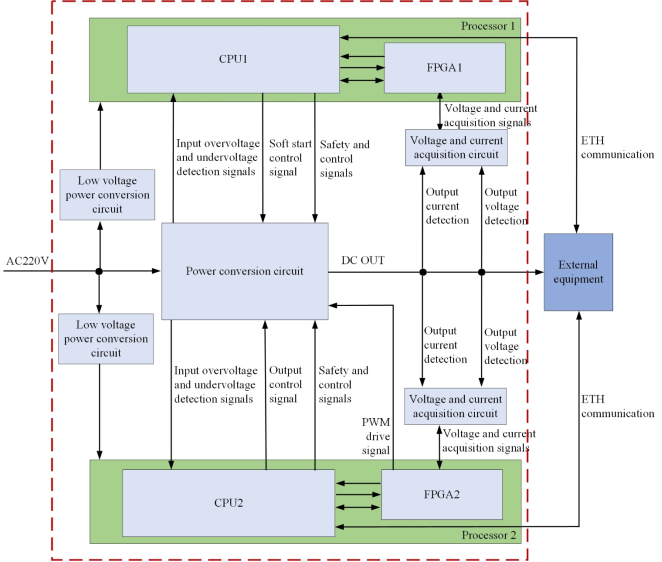
Figure 1. Module structure diagram.
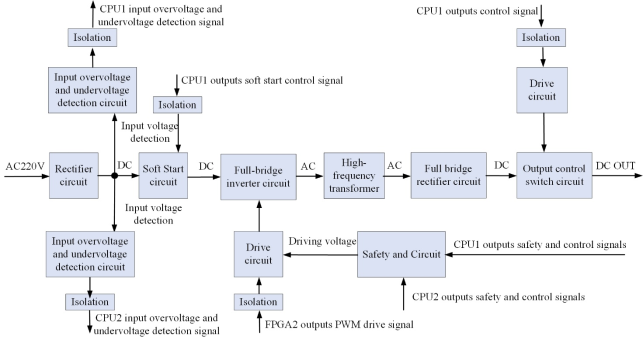
Figure 2. Block diagram of power conversion circuit structure.
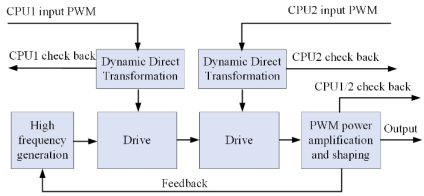
Figure 3. Block diagram of safety circuit structure.
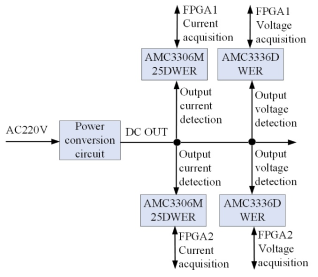
Figure 4. Structure diagram of voltage and current acquisition circuit.
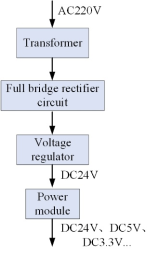
Figure 5. Structural diagram of weak current power conversion circuit.
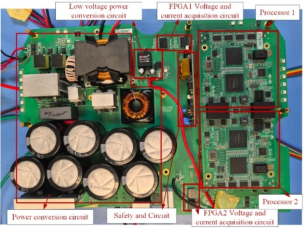
Figure 6. Experimental prototype.
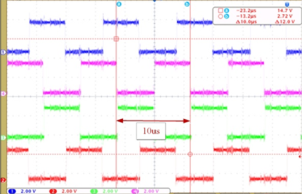
Figure 7. Four channels of 100kHz PWM waveforms output by FPGA2.
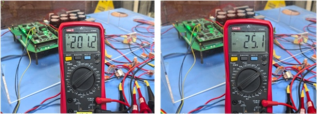
Figure 8. Output DC voltage value.




 Share This Article
 Twitter
 Linked In
 Facebook
 Copy
Copy Download